
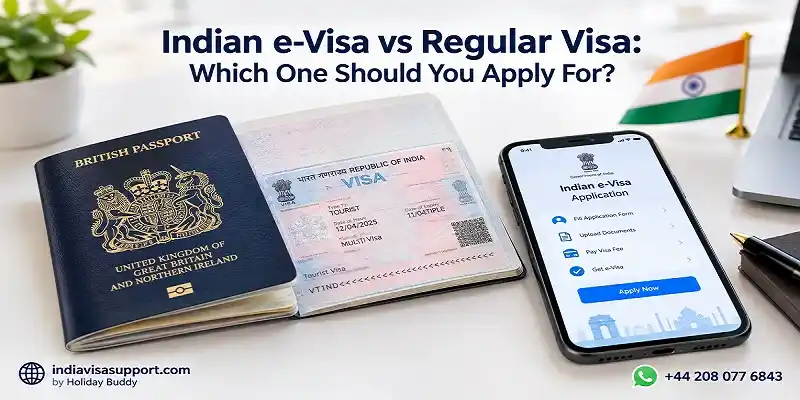
The simple answer to Indian e-Visa vs Regular Visa is this: if you’re flying into India through a major international airport, your trip is 30 days or less, and you need your visa fast — go for an e-Visa. You apply online, don’t need to send your passport anywhere, and it usually comes through in 2 to 5 working days. Simple, quick, done.
But if you’re entering India by land border, or you plan to visit often over the next few years, or you’re going for work or study — a Regular Visa makes more sense. In the Indian e-Visa vs Regular Visa comparison, the Regular Visa lets you enter through any authorised checkpoint (land routes included), stays valid for up to 10 years with multiple entries, and covers categories like employment and student visas that an e-Visa simply doesn’t.
So basically: e-Visa is for speed and short trips. Regular Visa is for flexibility and the long game. Which one you pick depends on how you’re entering, how often you’ll travel, and what you’re going there for.
Still confused about Indian e-Visa vs Regular Visa?
Message us — me or my team will help you sort it out.
No consultation charges. We’ve been in this industry for 12 years, serving customers across the UK and all over the World
Who Should You Actually Choose? Let’s Break It Down
Who is the e-Visa (Electronic Visa) suitable for?
How to apply: Completely online. Fill the form on the official website indianvisaonline.gov.in, upload your passport scan and photo. Once approved, the ETA (Electronic Travel Authorization) will arrive on your email — print it and show it at the airport. No need to courier your passport, no need to visit the embassy.
Fees (for US passport holders):
- 30-day e-Tourist Visa: $25** (July-March), **$10 (April-June off-season)
- 1-year e-Tourist Visa: $40
- 5-year e-Tourist Visa: $80
Processing time: Normally 72 hours (3 working days). Official says 95% of applications are approved within 72 hours. Keep a 2-week buffer during peak season.
Entry points (IMPORTANT UPDATE): Now e-Visa is not just from 16 airports — you can enter through 88 international ports, which include 37 airports, 38 seaports, and 13 land ports. Land ports like Attari (Road), Raxaul, Jogbani, Darranga, Gede, Ghojadanga, Haridaspur, Jaigaon, Dawki, Moreh, Agartala have been added. But if your specific entry point is not on the list, you will need to apply for a Regular Visa.
Limitations:
- Maximum 3 times in one calendar year (January to December).
- Not available for Diplomatic/official passport holders.
- Pakistan passport or Pakistan-origin people will have to apply for a Regular Visa only.
- There is no emergency or fast-track service for e-Visa.
Stay rules (UK citizens): 30-day visa is double-entry; 1-year and 5-year are multiple-entry, but for UK, US, Canada, Japan citizens, you cannot stay more than 180 days at a time.
Quick Note: If you hold a UK or US passport but have ancestral cross-border roots, your limits change entirely. Please message us on WhatsApp to quickly cross-check your profile before picking a channel.
Chat on WhatsAppWho is the Regular Visa suitable for?
How to apply: Through VFS Global visa centers. After filling the online form, you have to go to the visa center yourself — with the printed form, original passport, photos, and supporting documents. The passport is submitted there for the sticker to be applied, and then returned to you.
Fees (for US passport holders): Tourist visa $160, valid up to 10 years, multiple-entry . Applying for an e-Visa again and again works out more expensive in the long term.
Processing time: Normally 5-10 working days, longer if the embassy asks for extra documents. Your passport is not with you during processing, so do not confirm travel plans in advance.
“Check your visa status and immigration details on the official BOI portal.”
boi.gov.inQuick Comparison Table: Indian e-Visa vs Regular Visa
| Thing | e-Visa | Regular Visa |
|---|---|---|
| How to apply | Completely online | Online form + visit VFS center |
| Passport submission | No, only scan | Yes, original for sticker |
| Processing time | 72 hours (3 working days) | 5-10 working days |
| Entry points | 88 international ports (37 airports, 38 seaports, 13 land ports) | All authorized check-posts |
| Max validity | 5 years | 10 years |
| Fees (US citizens) | $10-$80 | $160 (10 years) |
| Suitable for | Tourism, business, medical, conference | All categories |
| Land border | ✅ Yes (limited ports) | ✅ Yes (all check-posts) |
“Flight in the next few days and your visa is stuck? Get urgent help now.”
Emergency Visa HelplineFrequently Asked Questions
Can I change my e-Visa into a Regular Visa after reaching India?
No. Not at all. Once you enter India on an e-Visa, its type and duration are locked. The government is strict about this. If you later need to stay longer for work or studies, you will have to leave India and apply for a fresh Regular Visa from an embassy abroad. There is no shortcut.
What if I try to enter India through a land border with an e-Visa?
Immigration will send you back right there. A lot of people make this mistake — they think a visa is a visa, and it doesn’t matter where you enter from. But an e-Visa is only valid at certain designated airports, seaports, and a few land ports. If you are planning a road trip through the Nepal or Bangladesh border, check first whether that port is on the list. If it’s not, you will need a Regular Visa.
If my application gets rejected, do I get my money back?
No. The fee is non-refundable — and this applies to both the Indian e-Visa vs Regular Visa options. Whether it’s an e-Visa or a Regular Visa — you don’t get the money back either way. The immigration department charges you for processing the application, not for guaranteeing the visa. So double-check every detail when filling out the form.
How early should I apply for an e-Visa?
Official processing time is 2 to 5 working days. But don’t leave it for the last minute. Apply 7 to 10 days in advance. Sometimes the system has technical issues or they ask for extra documents. That way, you still have time on your side.
Confused between Indian e-Visa and Regular Visa? Request a free document review before you apply.
Final Advice: Indian e-Visa vs Regular Visa
Go for e-Visa if:
- You are arriving through a major international airport
- Your trip is 30 days or less, and you visit occasionally
- You need the visa quickly and don’t want to courier your passport
- You are from an e-Visa eligible nationality
Go for Regular Visa if:
- You are entering India from Nepal or any land border
- You plan to visit India frequently over the next few years
- You need a job visa or student visa — which e-Visa does not cover
- You are looking at long-term cost
Confused between Indian e-Visa vs Regular Visa? Don’t guess and risk a rejection. Tell us your travel dates and purpose — we’ll tell you exactly which visa you should apply for. Free of charge.
Chat Now
Conclusion
Picking between Indian e-Visa vs Regular Visa is not just about speed or fees. It depends on how you are entering India, how long you plan to stay, and your purpose of travel. Get that right, and the rest becomes simple.
One important thing — if you hold dual nationality, the rules change entirely. To understand those rules, you can read our complete Indian Visa for Dual Citizens guide.
If you get stuck or your application is rejected, do not guess. We offer a 100% free document review to help you pick the right channel.
With the right visa choice, your journey becomes smooth from the very first step.
Pingback: Family Emergency in India? Indian Visa Options for Urgent Travel - Visa Support