
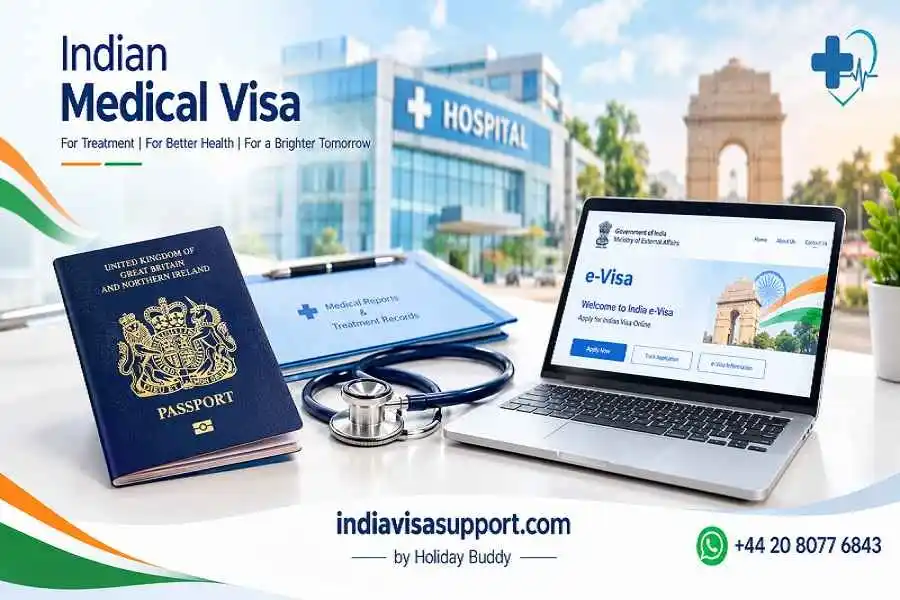
When we talk about global healthcare and medical tourism, India has now become one of the top destinations in the world. World-class hospital infrastructure, advanced clinical technology, and highly qualified specialists — and that too at much lower cost compared to Western countries. Because of this, India welcomes lakhs of international patients every year. Cardiac surgery, organ transplants, IVF, orthopaedics, cancer treatment — everything is available here. If you or your loved one is travelling for medical care, then getting an official Indian Medical Visa is the first and most important step.
Doing complex treatments or major hospital surgeries on a standard tourist permit is strictly prohibited. And choosing the wrong travel document can delay your application — or you may even face rejection at the airport. If you face an unexpected rejection during the planning phase itself, then the way to fix document or formatting mistakes is there in our guide — Indian visa rejection.
One more thing to keep in mind. Indian Medical Visa is not just for the patient. A limited number of attendants can also travel in it. So if any family member is coming with you, then they will have to get their own Medical Attendant Visa. We will cover this in detail below.
In this guide, we will cover — core eligibility criteria, different sub-categories (with electronic options), mandatory document checklist, processing timelines, and attendant rules — so that your medical travel stays completely smooth from start to finish.
Travelling to India from the UK? Get your Indian Visa sorted with our complete guide.
Types of Indian Medical Visas
Based on your medical treatment’s complexity and expected duration, the Government of India provides two main entry pathways:
- e-Medical Visa (Electronic Visa): This is specifically designed for short-term treatments, routine check-ups, or minor surgeries. The whole application process happens online — no need to mail a physical passport, no embassy visit, no long waiting queues.
Validity: Valid for 60 days from the exact date of your first entry.
Entries: Triple-entry. So if follow-ups are needed, the patient can go out and come back into India up to three times during the treatment period.
- Regular/Paper Medical Visa: This one is for long-term treatments, longer therapy courses, or major surgeries — like organ transplants, oncology cycles, or neurosurgeries. You apply for this through VFS Global or the nearest Indian Embassy. It can be extended up to 1 year. And if your treatment plan is not fully confirmed yet, or you need multiple extended stays, then this is the option to go for.
One important thing — the e Indian Medical Visa is not available for every treatment. If your doctor has advised a long recovery period or a complex procedure, then the Regular Medical Visa is the safer route.
Not sure which visa type is right for you? Compare e-Visa vs Regular Visa.
The Medical Attendant Visa Rule
The government understands that international patients need close personal care. That is why there is a dedicated companion visa — called the Medical Attendant Visa (or e-Medical Attendant Visa). This visa allows one family member or a trusted companion to travel with the patient and stay with them during the treatment.
- With one patient, maximum two (2) attendants are allowed.
- The attendants should be immediate family members or officially recognised companions.
- The attendant’s visa validity and entry rules match exactly with the patient’s visa.
- If the patient’s visa gets extended, then the attendant’s visa can also be extended accordingly.
- The attendant cannot take up any work or employment in India during their stay.
One important thing — the attendant visa is not automatic. Every attendant has to apply separately, and their application should be linked to the patient’s Medical Visa.
Always verify the latest Medical Visa rules on the official Government of India portal.
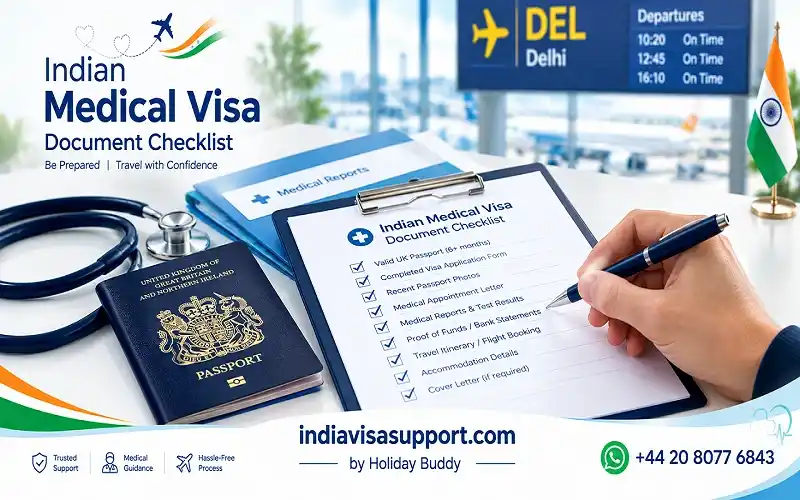
Indian Medical Visa Documents: Mandatory Document Checklist
Nobody wants their Indian Medical Visa application stuck. So before you start the online form, just keep these documents ready. Miss even one, and things can get delayed. So check each one properly:
- Valid Passport: 6 months minimum validity from your arrival date. And at least 2 blank pages. If your passport is about to expire, renew it first. No renewal, no visa.
- Official Hospital Invitation Letter (Crucial): This one is very important. A formal letter, signed, on the official letterhead of the recognised Indian hospital. It needs to mention the patient’s name, passport details, medical condition, and how long the treatment will take. Without this letter, your Indian Medical Visa won’t move forward.
- Local Medical Referral: Diagnostic reports, medical history, or a referral letter from your doctor back home. This letter should confirm that overseas treatment is actually needed. It helps authorities understand why you’re travelling to India.
- Digital Photograph: A recent passport-style colour photo. Front-facing, plain white background. No selfies. No coloured backgrounds. And the photo should be recent — within 6 months.
- Financial Sufficiency Proof: Recent bank statements or proof of funds. This shows that you can pay your hospital bills and support yourself during your stay. This one is a must for the Indian Medical Visa.
Need a custom document checklist and review for your Indian Medical Visa application?
Step-by-Step Application & Processing Time
Filling the application needs careful attention — especially when you are matching your personal details with the passport’s machine-readable zone (MRZ). Even one small mismatch here can delay your Indian Medical Visa.
Access the Official Portal: Fill the forms only on the official Government of India visa website. Stay away from lookalike third-party domains that add unnecessary service markups. These sites may look genuine, but they are not authorised.
2. Select the Correct Category: Carefully mark — e-Medical Visa for the patient, and e-Medical Attendant Visa for the travel companions. Choosing the wrong category is one of the most common reasons for rejection.
3. Upload and Pay: Attach your high-resolution passport scans, hospital invitation letters, and digital images, then pay the processing fee by credit card, debit card, or PayPal. Blurry scans or unclear photos will cause delays.
The standard processing timeline for an online e Indian Medical Visa is usually 3 to 5 working days. In normal circumstances, it is highly recommended that you submit your application at least 2 weeks before your scheduled flight — this gives you a comfortable administrative buffer. It also covers you for public holidays, verification issues, or any last-minute document problem.
But if any unpredictable health crisis comes up and you need immediate intervention, then look at the proper procedures for securing an emergency visa for India — so that your travel preparations can be fast-tracked. And if in a life-and-death situation, because of a stuck online system, you need urgent human assistance, then you can get contact details through the emergency visa for India helpline resource guide.
Need urgent help with your Indian visa? Get in touch with our emergency helpline.

Special Travel Scenarios: Layovers and Transits
For many international medical travellers, to reach India, they have to take connecting flights through different global hubs. And sometimes, the route is not direct. If your flight itinerary has a brief layover in India, and after that you have to go to some third neighbouring country for treatment — then you have to be careful.
One more thing to keep in mind. If you have to exit the airport’s international zone — to manually transfer baggage between separate terminals — then a specialised travel document is needed. You cannot simply go out and come back in without proper paperwork.
So in these short-term connection scenarios, understand the airside versus landside border cross rules carefully. Airside means you stay inside the airport’s international transit area and do not cross immigration. Landside means you exit the airport and enter India, even if it is only for a few hours. The rules for both are different, and if it goes wrong, there can be a serious problem at the airport.
Not sure about airside vs landside transit rules? Read our complete Transit Visa guide.
Frequently Asked Questions (FAQs)
Can I do major surgeries in India on a Tourist Visa?
No. Minor check-ups or wellness procedures are allowed on a tourist permit. But if it is a hospital admission, a major surgery, or long-term treatment — then you need a proper Medical Visa. Simple.
Can I extend my Medical Visa after reaching India?
Yes. If complications come up, or the treating doctor gives an official certificate saying the patient needs more recovery time, then you can apply for an extension locally. This is handled inside India through the FRRO portal.
How long does the Indian Medical Visa take to process?
Usually 3 to 5 working days. But apply at least 2 weeks before your flight. If there is any delay or public holiday, then you are still safe.
How many attendants can travel with one patient?
Maximum two. Each attendant applies separately for an e-Medical Attendant Visa. And their application should be linked to the patient’s Medical Visa.
Can I work in India on a Medical Visa?
No. No work. No employment. It is strictly for treatment and recovery. Attendants also cannot work during their stay.
What is the fee for an Indian Medical Visa?
For UK citizens, the Indian Medical Visa fee is $129 USD** (as of 2026). This is different from the e-Business Visa fee, which is **$242 USD for UK citizens. Medical visa fees are separate from business visa fees because they are different visa categories. The government fee is included in this amount. Payment by credit card, debit card, or PayPal.
What if my Medical Visa application gets rejected?
If it gets rejected, then the fee is generally non-refundable. First, find out the reason. Common reasons — missing hospital letter, wrong photo, or wrong visa category. Fix it and apply again.
Conclusion
Coming to India for medical tourism is now much easier than before. The e Indian Medical Visa’s online process has reduced the paperwork a lot. Earlier, people had to go to the embassy, submit physical documents, and wait for weeks. Now, most of the work gets done online — from a laptop or phone.
But still, there are a few things you need to be careful about. First, the letter you get from the Indian hospital should be absolutely clear. It should mention your name, passport details, medical condition, and how much time the treatment will take — everything should be there. Second, all your medical documents should be in proper format — diagnostic reports, referral letters, and bank statements. If anything is missing or unclear, then the application can get delayed.
Apart from this, apply at least 2 weeks before your flight. This gives you a comfortable buffer if any delay comes up. And until your visa is approved, do not book non-refundable tickets.
With the right preparation, both your travel and treatment will be completely smooth. And if you get stuck somewhere, then help is just one WhatsApp message away.
Facing a medical emergency and need to travel to India urgently? Read our Emergency Visa guide.
Chat Now
Pingback: How to Apply for an Indian Visa for Australian Citizens (2026 Latest Guide) - Visa Support