
The number of people travelling from the USA to India is increasing every year. Someone comes to see the Taj Mahal. Someone for a business meeting. Someone for yoga or medical treatment. India has now become a top destination for Americans. If you are an American citizen and planning an India trip, then first of all, understanding the Indian Visa for USA Citizens requirements and the new rules is very important.
One thing, clear it first. For US passport holders, Visa on Arrival is not available in India. You have to get a valid visa approval before boarding the flight itself. If you do not have a valid OCI (Overseas Citizen of India) card, then you will have to apply for an online e-Visa or a Regular Paper Visa through the embassy. Choosing the right category is very important. Even a small mistake can get your visa rejected. And for that, you will have to pay the fee again.
One more thing. India’s visa process has now become much simpler than before. Through e-Visa, you can apply online sitting at home. No embassy visit. No passport submission. Approval comes to your email. But every visa type has its own rules. And understanding that is the most important thing.
In this guide, we will cover everything about the Indian Visa for USA Citizens — visa types, fees, documents, processing time, and border entry rules. So that both your travel and visa process stay smooth.
Travelling to India? Get your Indian Visa sorted with our complete guide.
Indian e-Visa vs Regular Visa for US Citizens
US passport holders have two main options for an Indian Visa for USA Citizens. They should choose based on their travel preference:
- e-Visa (Electronic Visa): This is the most popular, fast, and 100% online way. You do not need to send your passport anywhere or go to a consulate. You can fill the form sitting at home, upload documents, and pay the fee. Approval comes to your email. This is best for short trips — tourism, business, or medical visits.
- Regular Paper Visa: If you need long-term validity up to 10 years, or you want to enter India from a land border (like Nepal or Bangladesh), then you will have to get a regular sticker visa through VFS Global. In this, you have to go to a visa centre, submit your passport, and the processing time is also longer. But for long-term travellers, this is more cost-effective — because with one visa, you can travel for many years.
One important thing — the rules for e-Visa and Regular Visa are different. e-Visa allows entry only from designated ports. With a Regular Visa, you can enter from any authorised checkpoint. So choosing the right visa is important. Before applying online, do check the comparison of both.
Always check the latest visa rules on the official Government of India portal before you apply.
Which Indian Visa for USA Citizens Should You Apply For?
For US citizens, different categories are available on the Indian Visa for USA Citizens e-Visa portal. Every category has its own purpose and stay limit. Choosing the right category is important — because with the wrong category, the application can get rejected.
e-Tourist Visa: This comes with 30-day (double entry), 1-year (multiple entries), and 5-year (multiple entries) validity. For US citizens, the stay limit rule is this: on an e-Tourist visa, you can stay continuously for a maximum of 180 days at one time. And in one full calendar year also, the total stay cap is 180 days only. This means — you can take a 5-year visa and travel again and again, but in one year, you cannot stay in India for more than 180 days.
e-Business Visa: If you are going for commercial visits — like meetings, corporate events, or market research — then select the e-Business Visa sub-category. Its validity is 1 year, and it allows multiple entries. But keep in mind — on this visa, you cannot do a salaried job. For that, a separate Employment Visa is needed.
e-Medical Visa: For short-term health treatments, the e-Medical Visa with 60 days validity is chosen. In this, 2 attendants are also allowed with the patient — meaning a family member or trusted companion can go along. For attendants, a separate e-Medical Attendant Visa has to be taken, which is linked to the patient’s visa.
One important thing — the Indian Visa for USA Citizens e-Visa allows entry only from designated ports. If you want to enter from a land border, then you will have to take a Regular Visa.
Need a custom document checklist and review for your Indian Visa for USA Citizens application?
Two Forms You Must Fill Before Entry
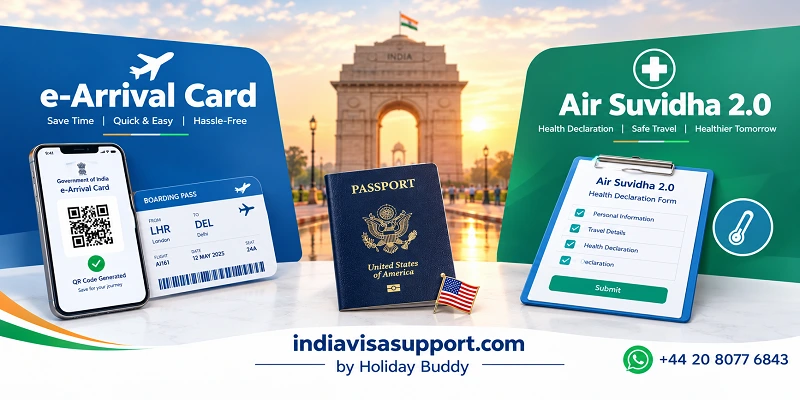
Apart from Indian Visa for USA Citizens approval, the Government of India has made two new digital forms mandatory to increase digital integration. People often forget these — and then face problems at the airport. So understand them carefully:
1. e-Arrival Card
The old paper slips that used to be given on flights are now discontinued. Now all foreign nationals have to fill a free digital entry declaration on the “Su-Swagatam” app or the official portal, 72 hours before landing. Its QR code has to be shown at the airport.
This is a mandatory step. It is not a visa or travel authorisation. But without it, the entry process is not complete. OCI cardholders also have to fill this form.
2. Air Suvidha 2.0
Air Suvidha was a health self-declaration form introduced during the COVID-19 pandemic. It is no longer mandatory for most international travellers. However, it can be re-introduced during specific health advisories or outbreaks. Before you travel, check the official Government of India portal to confirm if Air Suvidha is required for your trip.
Important: Air Suvidha is different from the e-Arrival Card. The e-Arrival Card is still mandatory for all foreign nationals
Need urgent help with your Indian visa application and e-Arrival rules? Read our complete guide.
Indian Visa Fee Breakdown for USA Citizens
According to the official government portal, the Indian Visa for USA Citizens charges are like this. Apart from this, there is also a card transaction fee of around 2.5% to 3% — this can be different depending on the bank.
| Visa Type / Duration | Processing Fee (USD) | Remarks |
|---|---|---|
| 30-Day e-Tourist (April to June) | $10 USD | Off-season discounted rates |
| 30-Day e-Tourist (July to March) | $25 USD | Peak season standard rate |
| 1-Year e-Tourist Visa | $40 USD | Multiple entries |
| 5-Year e-Tourist Visa | $484 USD | Long-term digital visa |
| e-Business Visa | $242 USD | Commercial trips |
| e-Medical Visa | $129 USD | Clinical care entry |
One important thing — looking at the fee structure makes the decision easier. If you are going to India once a year, then a 1-year visa is better. If you are going to travel again and again for 5 years, then a 5-year visa is more cost-effective — because by paying $160 one time, you can travel for many years.
And one more thing — the fee is set in USD, but at the time of payment, in whatever currency it is — your local currency— the amount can vary according to the exchange rate. So before payment, it is better to confirm with your bank.
Application Process for Indian Visa for USA Citizens
The Indian Visa for USA Citizens application is fully online. You just need to fill the form on the official portal. Upload your passport bio-page scan (PDF), a square white-background photo, and pay the fee. After that, your application goes into the system for processing.
This visa is provided by the Government of India. No agent or agency has any role in it. You apply yourself, you pay yourself, and the approval comes straight to your email. No middleman. So if someone tells you they can “fast-track” it for extra money — that is wrong. No such official service exists.
Standard processing takes 3 working days (72 hours). But if you have filled the form correctly — with all the right documents — approval can come in 24 to 48 hours also. This means no mistakes in the form, clear documents, and a photo as per specifications. If everything is correct, the process moves fast.
One thing to keep in mind — e-Visa allows entry only from designated ports. If you want to enter India from a land border, then you will need a Regular Visa, not an e-Visa. So choose the right visa based on your entry point.
Need help with your Indian Visa for USA Citizens? Chat with our experts on WhatsApp.
Emergency Visa for India for USA Citizens
Sometimes, an American living in the USA has to rush to India urgently. This happens when there is a sudden medical emergency or a life-and-death crisis in the family. In such cases, the standard online route for an Indian Visa for USA Citizens may not be fast enough. That is when the embassy’s emergency paper route comes in.
For this route, you have to go to the embassy or consulate. Carry your passport, flight tickets, and proof of the emergency. Proof is important — like a hospital letter, death certificate, or doctor’s statement. Without proof, this route cannot be used.
But remember — this is only for genuine life-and-death crises. Business urgency or a missed holiday deadline does not qualify. So use it only in a real emergency.
And one more thing — if you just need information on what to do, you can contact the emergency visa helpline. They will guide you properly. No charges for that.
Need urgent help with your Indian visa application and stuck on what to do? Read our complete guide.
Transit Indian Visa for USA Citizens
If you are just going through India to a third country, and you have to exit the airport transit area to re-check your bags, then instead of an Indian Visa for USA Citizens, you should travel with a transit visa for India.
Because an Indian Visa for USA Citizens is not valid for transit — and if you cross immigration without the correct visa, then you can face a problem at the airport.
One thing is important to understand — transit is of two types. In airside transit, you stay inside the airport’s international area, you do not cross immigration. In this, usually no visa is needed. But in landside transit, you exit the airport, cross immigration, or stay overnight. In this, you need a transit visa.
So check your itinerary — if you have to change terminals, or re-check your bags, or exit the airport, then definitely take a transit visa. Otherwise, entry can be refused at the airport.
Not sure if you need a visa for your layover in India? Read our complete transit visa guide.
Frequently Asked Questions (FAQs)
Do US citizens need a visa for India?
Yes. Americans need a valid Indian visa. There is no Visa on Arrival for US passport holders. So if you do not have a valid OCI card, you have to apply for an e-Visa or a Regular Paper Visa before you fly.
What is the difference between e-Visa and Regular Visa?
Simple — e-Visa is fully online. No embassy visit. No passport submission. Best for short trips. Regular Visa is for longer stays, up to 10 years. You apply through VFS Global. And with a Regular Visa, you can also enter India from a land border.
Which one should I apply for — e-Tourist, e-Business, or e-Medical?
It depends on why you are going. Tourism? e-Tourist Visa. Business meetings? e-Business Visa. Medical treatment? e-Medical Visa. And if you pick the wrong category, your application can get rejected. So choose carefully.
How long can I stay in India on an e-Tourist Visa?
Maximum 180 days at one stretch. And in one full calendar year also, the total stay cannot go beyond 180 days.
How much does it cost?
For the e-Tourist Visa — $10 for 30 days (April to June), $25 for 30 days (July to March), $40 for 1 year, and $160 for 5 years. e-Business Visa is $242. e-Medical Visa is $129.
Any other forms I need to fill?
Yes. Two more forms are mandatory. The e-Arrival Card — fill it 72 hours before landing. And Air Suvidha 2.0 — fill it 24 hours before travel. Both are separate from your visa. And both are required.
What if there is a genuine emergency?
First, clear one thing — there is no “emergency e-Visa.” The government does not fast-track e-Visas for extra money. Anyone promising that is a scam. But if you fill your application properly, with all the right documents, approval can come in 24 to 48 hours. That is the fastest route. For real life-and-death crises, the embassy runs an emergency paper route. Carry your passport, flight tickets, and proof of the emergency. Only genuine emergencies qualify.
Conclusion
Getting an Indian Visa for USA Citizens is not as difficult as people think. The process has become much simpler than before — everything is online, and if you choose the right category and fill the documents properly, then approval can come in 24 to 48 hours also. Just a few things to keep in mind. Choose the right visa type — tourism, business, or medical. Fill the form properly. Keep documents clear. And if you are entering from a land border, then take a Regular Visa instead of an e-Visa.
And yes — do not get into the trap of anything like an “emergency e-Visa.” No such official service exists. If you have a genuine emergency, then there is the embassy paper route — but that is only for real life-and-death crises. With the right preparation, your Indian Visa for USA Citizens process will be completely smooth. And if you get stuck somewhere, help is just one WhatsApp message away
Indian visa rejected? Don’t reapply blindly. Find out why and how to fix it.
Chat Now
Pingback: How to Apply for an Indian Visa for Australian Citizens (2026 Latest Guide) - Visa Support
Pingback: Indian e-Visa for Children: 5 Best Rules